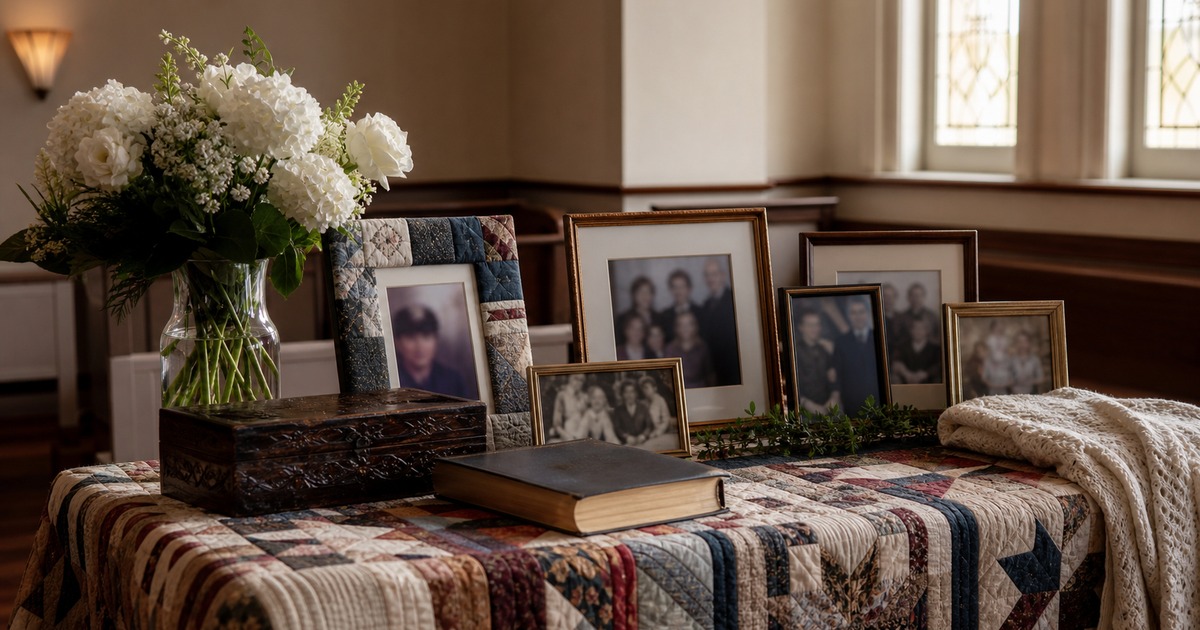
A funeral can feel personal without adding dozens of decisions. Choose two or three details that reflect the person's life, such as a favorite song, a photo display, a meaningful reading, a familiar object, or one story that captures their character. Let the rest of the service remain simple and well coordinated.
For guidance from a local funeral director, call Didericksen Memorial 24/7 at (435) 277-0050. Jay R. Didericksen serves families from 87 W Main St in Grantsville and throughout Tooele County.
Begin with one true detail
Ask what friends and family would immediately associate with the person. It might be a hymn, a quilt, a tool, a military photograph, a recipe, a fishing hat, or a favorite place.
Choose a small number of focal points
Two or three strong details usually feel more intentional than a room crowded with unrelated items. Select one visual element, one sound or reading, and one shared memory.
Use photographs with a purpose
A short photo sequence can show relationships and life stages without requiring hundreds of images. Assign one person to gather files and another to confirm names and dates.
Invite participation carefully
A family member may read, speak, offer a prayer, play music, or help create a display. Confirm roles in advance so no one feels pressured on the day.
Let the funeral director handle transitions
Personal details are most effective when the practical flow is clear. The funeral director can coordinate timing, entrances, music cues, cemetery departure, and communication with participants.
A practical sequence to follow
When the family is ready, use this visible sequence as a simple guide:
- Begin with one true detail
- Choose a small number of focal points
- Use photographs with a purpose
- Invite participation carefully
- Let the funeral director handle transitions
What families should keep in mind
The most useful planning question is not whether a service looks traditional enough. It is whether each part serves a purpose for the family and community. A familiar structure can provide steadiness, while a few personal details keep the gathering connected to a real life and story.
Keeping decisions manageable
Didericksen Memorial can coordinate the practical details while the family focuses on people and memories. That may include timing, locations, cemetery communication, obituary information, transportation, and a clear sequence for guests.
Related guidance from Didericksen Memorial
The primary service resource for this topic is Didericksen Memorial. Related articles include:
Local support in Grantsville and Tooele County
Didericksen Memorial serves families in Grantsville, Tooele, Stansbury Park, Erda, Lake Point, Stockton, Rush Valley, Vernon, and nearby Utah communities. Local knowledge can help coordinate relatives, churches, cemeteries, care facilities, military contacts, and guests traveling across the county.
To ask a question or begin planning, call Didericksen Memorial 24/7 at (435) 277-0050 or visit the contact and location page.
Questions to bring to a conversation
A conversation about how to personalize a funeral does not need to cover everything at once. Write down the questions that matter most to your family, identify which facts are confirmed, and note any traditions or relationships that may affect the plan. Useful questions based on this topic include:
- How should we approach begin with one true detail in our family's situation?
- How should we approach choose a small number of focal points in our family's situation?
- How should we approach use photographs with a purpose in our family's situation?
- How should we approach invite participation carefully in our family's situation?
- How should we approach let the funeral director handle transitions in our family's situation?
Preparing before you call
For each possible service element, ask whether it helps people gather, remember, participate, or say goodbye. If it does not serve one of those purposes, it may not be necessary. This filter keeps the ceremony personal without making the plan harder to carry out.
The goal is not to arrive with a finished answer to how to personalize a funeral without making it complicated. It is to give Jay R. Didericksen enough context to explain the options, identify the next required step, and help the family separate immediate responsibilities from decisions that can wait. That kind of preparation protects clarity without adding pressure.
Applying this guidance to your family
No article can account for every family relationship, faith tradition, travel concern, or timing question. Use the guidance on begin with one true detail and choose a small number of focal points as a starting point, then identify where your circumstances differ. Write down those differences before the arrangement conversation. Specific questions help the funeral director give specific answers, while broad assumptions can leave relatives expecting different things.
What to confirm before details are shared
Before relatives, guests, or community members are given information about how to personalize a funeral, confirm the names, dates, locations, authorizations, and responsible contact. Mark tentative details as tentative. If a service element depends on a cemetery, hospital, military branch, clergy member, or another organization, wait for confirmation before publishing it in an obituary or sending it through family messages.
A final local planning check
Consider how the plan will work for people traveling between Grantsville, Tooele, Stansbury Park, Erda, Lake Point, and other parts of Tooele County. Confirm addresses, drive time, accessibility, weather concerns, and who will communicate changes. Then return to the central question in how to personalize a funeral without making it complicated: choose the approach that is accurate, manageable, and most consistent with the person and family being served.
Frequently Asked Questions
How many personal details should a funeral include?
There is no required number. Two or three thoughtful details are often enough to make the service feel connected to the person's life.
What can be placed on a memory table?
Families may use photographs, awards, hobbies, military items, artwork, books, or other appropriate keepsakes.
Can guests share memories?
Yes. Memories may be shared during the ceremony, at a reception, on cards, in a guest book, or through an online obituary.
Can a traditional funeral still feel personal?
Yes. A familiar service structure can be combined with music, readings, photographs, stories, and traditions that reflect the individual.
A final note for families
The most useful answer to how to personalize a funeral without making it complicated is one that fits the actual family rather than an imagined perfect plan. Review the guidance on use photographs with a purpose, identify any decision that still depends on another person or organization, and keep one written list of confirmed details. Didericksen Memorial can help families in Grantsville and throughout Tooele County understand what must happen next, what choices remain open, and how to communicate the plan clearly without making a difficult period feel more complicated.
If questions remain about how to personalize a funeral, bring them to the arrangement conversation rather than guessing. A direct answer from Jay R. Didericksen can help the family move forward with accurate information and a plan that reflects local circumstances.